
Writ of Distress in Malaysia: A Simple Guide for Landlords and Tenants
By Athira Binti Abd Mallek – 18 March 2026
Disputes between landlords and tenants, particularly those involving unpaid rental are not something uncommon in Malaysia. The issue becomes more serious when a tenant fails to pay rent but continues to occupy the premise. Many landlords are unsure of their legal rights and resort to extreme measures, such as changing the door locks or forcing the tenant to vacate the premise. This raises the question: can a landlord take such actions? The answer is NO. Regardless of how frustrated a landlord may feel, he or she must act in accordance with the law. One of the legal remedies available to landlords is the Writ of Distress under the Distress Act 1951.
Situation:
You and Z enter into a tenancy agreement, where you agree to rent out your premises in return for Z paying monthly rental. After a few months, Z starts to default on his rental payments and refuses to communicate with you. However, you know that he is still occupying the premises.
What can you do? How can you recover the arrears of rental from Z? Can you kick out Z on your own?
In this situation, as a landlord, you can initiate a Writ of Distress against your tenant.
What is Writ of Distress?
Writ of Distress is a court order that directs the Bailiff (on behalf of the landlord) to seize and sell a tenant’s movable property to recover arrear rent.
In simpler word, you can recover rental arrears by distrain Z’s movable property (e.g: sofa, television, refrigerator). The governing law for Writ of Distress is the Distress Act 1951 (“DA 1951”).
How to start the process?
Before you consider initiating the process of Writ of Distress, there are few important matters you need to consider. First, there must be a valid tenancy agreement between you as the landlord and Z as the tenant. Second, you need to consider how many months that Z has failed to pay rent. Under Section 5(1) DA 1951, a landlord can only recover up to twelve completed months of rent immediately preceding the date of the application for a Writ of Distress. Third, you should consider whether Z has valuable on the premises. If the premises are fully furnished, Z may not have many valuable movable items to cover the outstanding rental arrears.
[1] to take and sell property from someone who owes you money in order to pay back their debt
What kind of movable items can be seized?
There are certain items that are protected by the law and cannot be seized. Under Section 8 DA 1951, such items for example are: –
1. Things that are in actual use (either held/worn/operated) of a person at the time of seizure;
2. Tools and implements not in use;
3. Tool of trades;
4. Necessary clothing and bedding for the tenant and his family;
5. Goods not belonging to the tenant;
6. Goods in custody of law; and
7. Government property.
What are the procedures?
The procedures can be found in Order 75 of the Rules of Court 2012.
To initiate Writ of Distress: –
1. an ex parte Originating Summons supported by affidavit should be filed;
2. attend hearing of the originating summons;
3. after the hearing, court will give its order in terms and Writ of Distress will be issued in Form 186;
4. then, the bailiff will then seize the tenant’s movable items in the premise and make an inventory and an approximate valuation;
5. a notice of seizure with a copy of the inventory and valuation attached, to inform him the amount due under the Writ of Distress and the time and place of sale of the items, unless he pays the amount due within five (5) days from the date of notice .
Once the tenant’s property is sold, the net sale will be used to satisfy the arrears rental due by the tenant to you.
[2] Section 9 (1) of the Distress Act 1951
Can I also claim double rent under Section 28(4)(a) of the Civil Law Act 1956?
In the case of Sherifah bt Salim v Aldy Sdn Bhd3 , the court held:
“the landlord could not distrain for arrears of double rent for holding over after the determination of the tenancy by way of a writ of distress under section 5 of the Distress Act 1951. Section 5(1) speaks of “rent due or payable”. It must be the rent due or payable under the tenancy agreement. Once the tenancy had been determined there was no further rent due or payable. The landlord was not entitled to claim for any rent thereafter, let alone double rent. The tenant who held over became a trespasser.”
However, there may be limited circumstances which could amount to an exception, depending on the facts of the case.
What happens after I have recovered the arrear rental? Can I kick out my tenant on my own?
The answer to that is NO. A Writ of Distress must be distinguished from an action for eviction/vacant possession. A Writ of Distress does not include eviction of the tenant, unless the tenant voluntarily deserts or abandons the premises. It does not entitle the landlord to recover possession of the premises.
The following is a simple comparison between a Writ of Distress and an eviction/Writ of Possession for your guidance: –
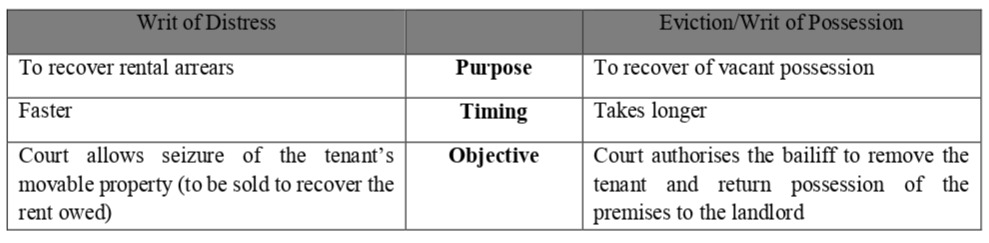
In conclusion, a Writ of Distress is a procedural remedy and an efficient, fast option for you to recover your rental arrears. However, it focuses strictly on recovering arrears of rent only, and not other claims such as utility bills, damages, or compensation.
Note: This article is provided for general informational purposes only and does not constitute legal advice. The facts and circumstances of each and every case will differ and therefore will require specific legal advice. Feel free to contact us for legal consultation.
[3] [2003] MLJU 838