
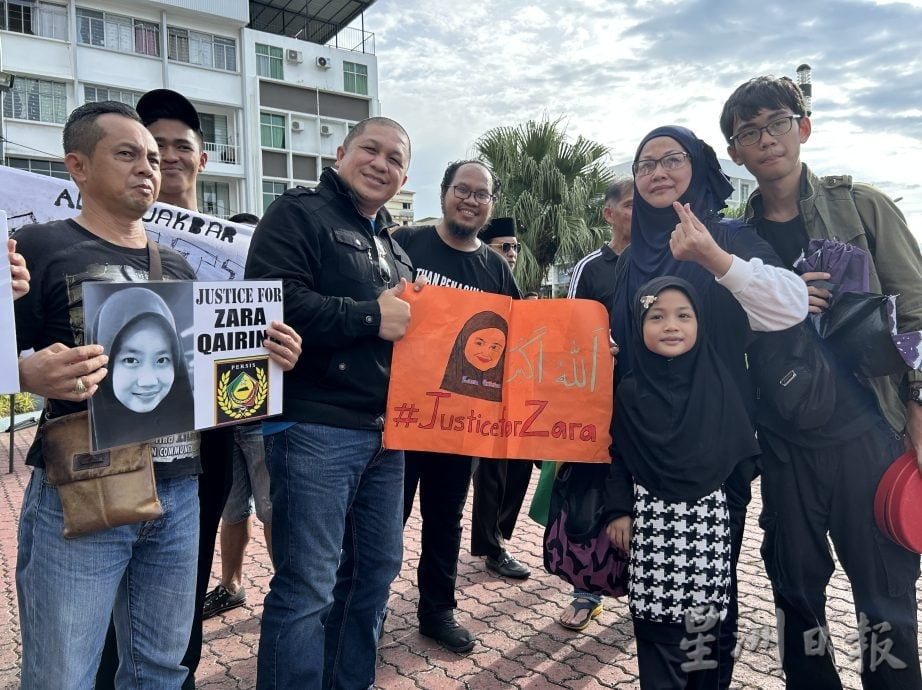
“Why do the Attorney General’s Chambers and the police fail to take bullying cases seriously? Aside from vague legal definitions and integrity issues among certain bad apples, I believe the core issue lies in the mindset and awareness—or lack thereof—of most law enforcement officers, and indeed our society at large.”
In the case of Zara, the 13-year-old student from Sabah whose death shocked the nation, there have already been significant developments due to public pressure: Prime Minister Anwar personally ordered the exhumation of her body for an autopsy, and an inquest has been launched to determine the cause of death.
Now, there has been another major breakthrough: the Attorney General’s Chambers has officially brought criminal charges in the Kota Kinabalu Children’s Court against five female students, all minors.
What’s especially noteworthy is that this case involves serious elements of school bullying, and it also marks the first time the AG’s Chambers has invoked Section 507C (1) of the Penal Code – a provision that only came into effect in March this year. This section was part of a broader set of amendments passed by Parliament last year to address the growing threat of cyberbullying and other forms of harassment. Sections 507B to 507G were introduced with the aim of tackling this emerging trend of bullying-related crimes.
However, questions have been raised. The lawyer representing Zara’s parents criticized the authorities for charging the accused under a provision perceived as too lenient—Section 507C (1), which carries a maximum sentence of only one year’s imprisonment or a fine, or both. They argued that Section 507D (2), which allows for up to 10 years in prison, should have been applied instead.
In my view, this already exposes one of the major flaws of this new law: too many of its provisions contain vague and overlapping elements, making selective prosecution a real risk.
For instance, if you carefully compare the newly added sections, they almost uniformly repeat similar language – terms like “using threatening, abusive or insulting words,” leading to victims feeling “harassed, distressed, fearful, alarmed, or harmed.”
Crucially, as the Minister in the Prime Minister’s Department (Law and Institutional Reform), Azalina, herself acknowledged, the term “bullying” is not specifically mentioned or defined anywhere in the law. Most of the provisions carry punishments of only 1 to 3 years’ imprisonment at most.
The only particularly severe provision is Section 507D (2), which explicitly mentions acts of provocation that lead the victim to attempt suicide. This offence carries a maximum penalty of 10 years’ imprisonment or a fine, or both.
In summary, in this tragic and high-profile case that has gripped the nation, the AG’s Chambers chose to prosecute the five classmates accused of bullying Zara under the most lenient provision of the so-called anti-bullying law – and explicitly emphasized that this charge is unrelated to Zara’s cause of death.
How is this acceptable?
In this regard, I fully agree with the lawyer representing Zara’s parents: the authorities should have opted for a more proportionate charge, specifically Section 507D (2), which carries the heaviest penalty—up to 10 years’ imprisonment.
At the very least, they should have waited for the results of the upcoming inquest to determine whether there is a direct causal link between the bullying and Zara’s death. Why rush to prosecute before the facts are fully known?